
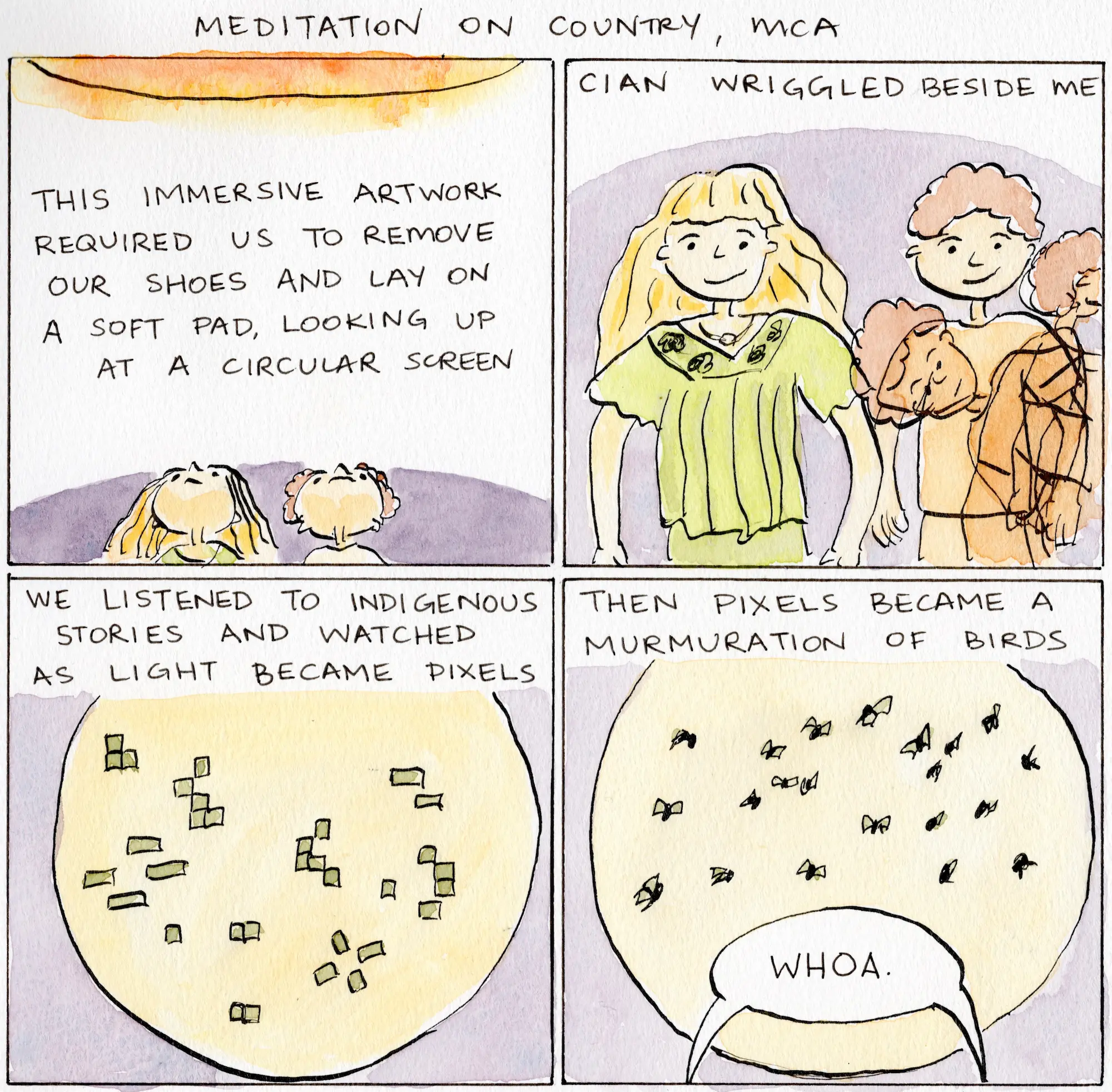
At the beginning of this week, Automatticians around the world were given a homework assignment: take a couple of hours of work time to visit a museum, and share any cool findings with the rest of the company. Why? Because exposure to the best works and history of others helps us elevate our craft.
Pretty amazing place to work, right?
I’m an avid museum-goer, so I started planning my visit immediately. I’m a member of the Art Gallery of NSW, so I go there quite often. I wanted to see what was on at other museums in Sydney.
Then, bingo! I found DATA DREAMS: Art and AI at Sydney’s Museum of Contemporary Art.


Given my interest in all things creativity and AI, this was the perfect fit, so I headed there with my younger son.
A selection of works
Three works from the exhibit stood out to me in particular:
Floating Points, 2025 by Anicka Yi
These unique kinetic sculptures hung, glowing, above a sinuous black base. Each was made of glowing fibre optic cable, and had articulated acrylic “tentacles” that slowly curled up and down. They were modelled on single-cell micro-organisms, but reminded me of jellyfish, slowing floating.
Anatomy of an AI System, 2018 by Kate Crawford and Vladan Joler
This work was about the environmental impact of AI. It comprised three pieces: a deconstructed Amazon Echo device, a collection of mineral samples, and a large schematic-style diagram on the wall. The artwork invited the viewer to consider the multiple materials, systems, people, engineering, and resources that contribute to every AI prompt.
This one definitely made me think about my role at the top of the “food chain” of AI processes, and the impact my AI choices have on all of those systems.


Meditation on Country, 2024 by Angie Abdilla
To experience this immersive artwork, we needed to take off our shoes and enter a dark room with a large, circular pad on the floor. We lay on this pad, looking up at a circular screen on the ceiling, to watch a 23-minute long video. The video was meditative, featuring mostly abstract forms moving, growing, shrinking, and pulsing to the sound.
A narrator shared Indigenous oral history about the origins of the universe, while images conjuring up the big bang and a murmuration of birds played on the screen. It was relaxing and also thought-provoking, the juxtaposition of ancient cultural history and astrophysics telling a rich story about our understanding of science.

AI ruminations
Along with artist statements, adorning the walls of the exhibit were short passages prompting the viewer to consider one aspect of AI.
One raised the topic of how AI seems to be autonomous, but still actually depends on “unseen human work.” Like the 18-century hoax known as the “Mechanical Turk” (which appeared to be a chess-playing machine, but actually had a human operator inside), we must question how much AI can actually do by itself, and how much is manipulated and directed by humans.
I’m so grateful to Automattic for encouraging this company-wide patronage of local museums. I’ve long believed in the power of museums to provoke thought, expose us to ideas and expression, and bring people together.

Leave a Reply