
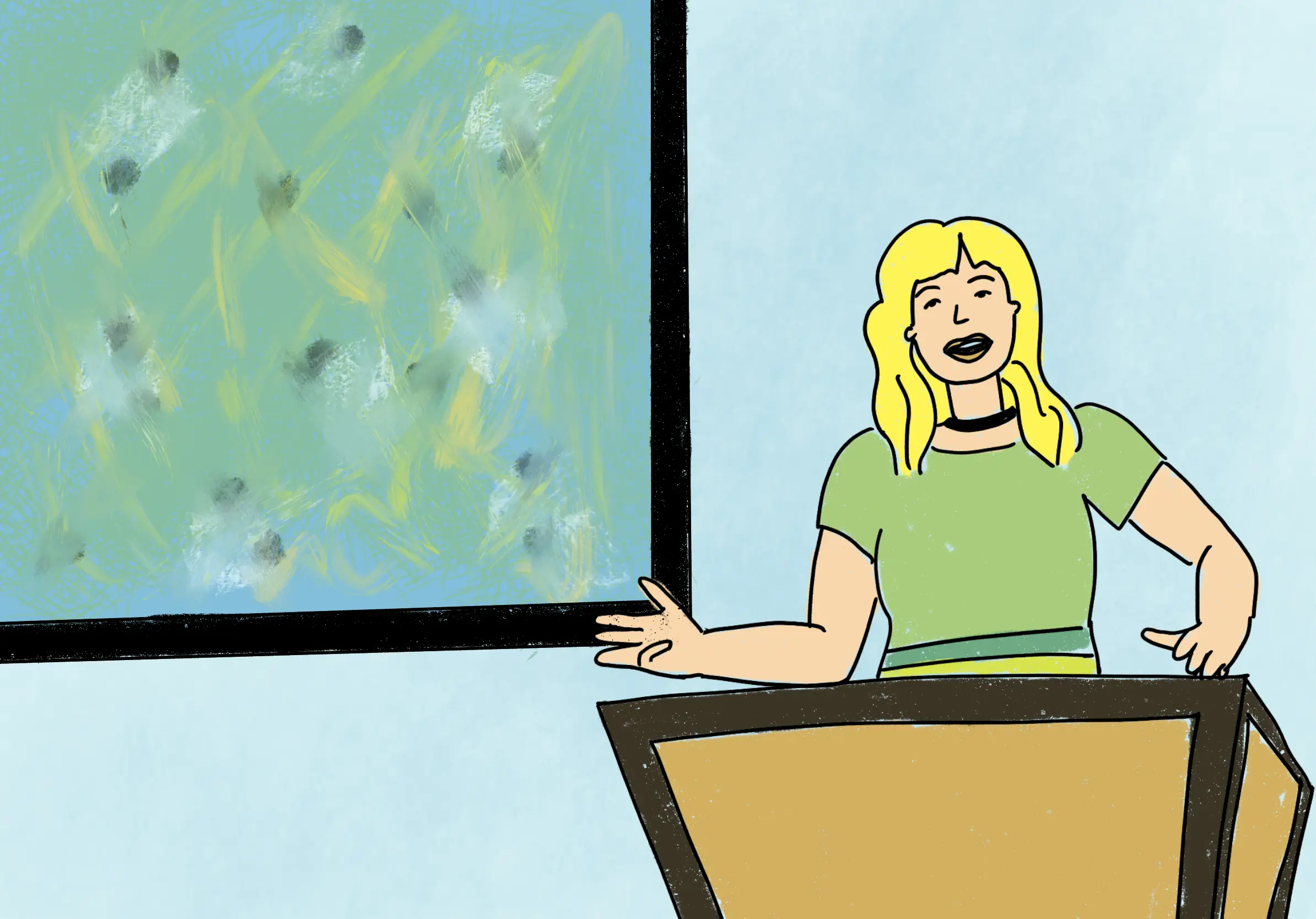
For me, each experience speaking at an event is an opportunity for creativity. What could have been an arduous process, that takes me away from other creative projects, becomes a source of joy. I find ways to weave in illustration, comics, and crafts, making the process creatively fulfilling while also producing a talk that is uniquely me.
Since I often meet people at events who ask me about my process, I thought I’d share some tips on putting together creative conference talks.
- 1. Realise that it takes time
- 2. Remember I am a compost heap
- 3. Brainstorm freely
- 4. Keep a notes doc
- 5. Write a blog post
- 6. Share what I know
- 7. Use AI thoughtfully…
- 8. … then throw it out and go with my gut
- 9. Spend time on the slides
- 10. Live far away…
- 11. Make the slides personal
- 12. Introduce myself
- 13. Be funny
- 14. Be vulnerable
- 15. Have a giveaway
- 16. Be myself
- 17. Don’t follow the rules
1. Realise that it takes time
It’s important to have realistic expectations up front. Putting together a talk for a conference or other event takes time. And making it creative adds even more length onto that timeline.
Even if a talk seems spontaneous, chances are it has gone through many hours of researching, interviewing, drafting, polishing, designing, and rehearsing.
So, I start early. And I plan on working on the talk, perhaps in small pieces here and there, for a long time. Thoughts take time to mature, and I need to give them space to breathe and opportunities to connect with other thoughts.
2. Remember I am a compost heap
I love this quote from Ann Patchett about where creative ideas come from:
“You will take bits from books you’ve read and movies you’ve seen and conversations you’ve had and stories friends have told you, and half the time you won’t even realize you’re doing it.
I am a compost heap, and everything I interact with, every experience I’ve had, gets shoveled onto the heap where it eventually mulches down, is digested and excreted by worms, and rots.
It’s from that rich, dark humus, the combination of what you encountered, what you know and what you’ve forgotten, that ideas start to grow.”
—Ann Patchett, This is the Story of a Happy Marriage
As I think about my topic, I try to let all the ideas percolate and mulch together in my brain. I want to fill it with as many inputs as possible, so I have more opportunities for great ideas to grow.
I gather as much research and inspiration on my topic as possible. So many, that just the idea of whittling them down is exhausting. Perhaps it’s just a habit from my years in academia, but I want to find as much as possible that has already been written (in credible places) on my topic. (Make sure you cite any references used in your talk!)
3. Brainstorm freely
Early in the thought process, I give myself opportunities to write in a freeform, stream of consciousness manner. Write down everything I am thinking, without a filter, without second guessing. This doesn’t have to be shown to anyone, but it might lead somewhere.
This phase of divergent thinking is really fun for me. My creative brain is working overtime, and the possibilities are endless. I try to repeat it several times, while I’m gathering my research and learn more about the topic.
4. Keep a notes doc
It doesn’t really matter where this is, or whether it’s digital or analog. I prefer the Apple Notes app, because I always have my phone, iPad, or computer near me, and the notes sync across devices. I never know what I’ll have with me when I have an idea or want to work on it.
This means that as ideas come to me, I can jot things down right away. I let the ideas percolate while driving, in the shower, etc, and sometimes a flash will come to me and I can note it down.
5. Write a blog post
When I’ve amassed enough research and thoughts about the topic, it’s really helpful to write it up as a blog post. Writing is a great way to clarify thoughts, and drafting it as a blog post forces me to create structure for my take on the topic. And usually, I’ll want to publish the talk as a blog post anyway (typically, that’s after I’ve given the talk).
Writing in a blog post format is a great way to advance the structure of the topic, but it’s important to keep in mind that a talk is a different format to a blog. For the talk, it’s important to deliver it in a more conversational, spoken, style. I make sure not to fall into the trap of just reading out the blog post, as that makes for a pretty lifeless presentation.
6. Share what I know
I get turned off when speakers get prescriptive about their advice, rather than acknowledging that most topics are nuanced, and there’s rarely a one-size-fits-all universal truth. In my opinion, it’s much more effective to share my thoughts on the topic from my own experience. That’s more approachable, more relatable, and more humble. And, it opens the door to a conversation. You never know, I might even change my mind!
“How to…” might get people in the door, but it’s “How I…” that will make a talk memorable.
7. Use AI thoughtfully…
There are pros and cons to using AI in creative work. But not all AI is generative, and it is possible to use even GenAI thoughtfully to make a talk better.
Generating AI writing too early robs me of the important process of having my own unique thoughts about a topic. Writing is a form of thinking, and if I outsource the first draft, I don’t get the chance to think.
I prefer working side-by-side with AI, going back and forth between a tool that can help to illuminate a topic from another angle, give simple explainers, or help with research. Or, after I’ve written a messy first draft, I like to ask AI to check if there’s a better way to structure the flow.
8. … then throw it out and go with my gut
I trust myself more than I trust AI. If my gut is telling me that the output isn’t working, or I’ve lost too much of my personality, I’ll stop using it, starting again with a more manual process.
9. Spend time on the slides
I always start with a written draft, but at some point, it feels like the right time to jump into slides. Moving into the visual realm helps me to play around with how to communicate my ideas, and to see whether the overall structure works.
It’s super important to have a cohesive design for the slides. Sometimes, I use a template, but I also look for visual inspiration from a range of sources, like artworks or books. I make sure that the slides have plenty of white space and reinforce my points with the fewest possible words.
10. Live far away…
… and have a lot of long plane trips to work on slides. 😆
Sure, this might be the hardest advice to follow, but since I live in Australia and travel quite a bit for work, I’m often taking long-haul flights that are the perfect opportunity to make art for my slides.
On one long international flight, I worked on this “fauxsaic” title slide for a flash talk about my sabbatical. It was so time-consuming but also so pleasurable!

11. Make the slides personal
I always like to add a personal touch to my slides. In the research and brainstorming phase, usually a creative visual idea will come to me that I can use throughout the slides. Including illustrations, photos, and even gifs is a good way to give some pizazz to even the most “boring” topics!
This visual idea will often also inform a theme that I can latch onto to make my talk more memorable. For my 2024 talk at MarketingProfs B2B Forum, I created hand-embroidered illustrations of obsolete communication technology, and then I took the metaphor a step further to talk about the “threads” of remote creative leadership!

Not only was this a fun and creative way to express myself, it also gave me a fulfilling art project to work on. When embroidering in front of the TV at night, my kids didn’t believe me when I said I was making a slideshow. 😂
12. Introduce myself
When a speaker doesn’t tell me who they are at the start of the talk, I feel ungrounded. I don’t know their perspective on the topic, or their experience that helps me understand where they are coming from. I expect all talks to be borne out of something personal, so when the speaker doesn’t share the basics about themselves, it’s harder to remember the takeaways.
I usually give a very brief introduction, including my name, where I’m from, my current role and company, and often another factoid that’s relevant to the topic or the audience. I also include a photo or sometimes an artwork.

13. Be funny
If something about your topic delights you, or seems absurd, I like to joke about it. Humour is almost always a good thing, and I don’t take myself too seriously.
Of course there’s a balance here, because I still want to share useful information and be taken seriously. But being creative often means seeing the funny side of things, and if I can make my audience laugh, I know that they will remember more of what I have to say.

14. Be vulnerable
I also think it’s good to be vulnerable in a talk. If I have a personal story relevant to the topic, I tell it! It might feel a bit embarrassing to share, but I can always change names or tweak some details. Sharing these pieces of myself and my own experience lends credibility to the talk, and also helps make it memorable.
15. Have a giveaway
I spend so much time and effort making my talk creative. But apart from potentially being recorded, it’s ephemeral. Once it’s over, it’s over.
So, a few times, I’ve decided to create a giveaway related to the creative theme of my talk. Audience members usually love these, and as an added bonus they act like a business card, something for people to remember you by.


16. Be myself
People aren’t just there to hear the topic from an objective point of view. They are there to learn how I approached this challenge, and what my unique spin and learnings are. So I make sure that I’m looking for the opportunities to root the topic in the personal, but be extendable to the audience.
Diversity is great! The more the better! Wouldn’t it be boring if everyone acted like how they thought “Person Giving an Important Talk” should act? We’d end up in a sea of sameness, a totally boring landscape of anti-personality.
17. Don’t follow the rules
Remember, creativity is personal. It requires processing inputs through your own experiences, taste, skills, etc. That’s beautiful, because it means that no two artists’ creations are the same.

But also, what has worked for me might not work for you. I hope you find something here to try, and if you do, please let me know!
Leave a Reply