My blog writing process

Writing a blog post takes time. Here are the final steps I take before hitting publish, including how I use AI without losing my voice.

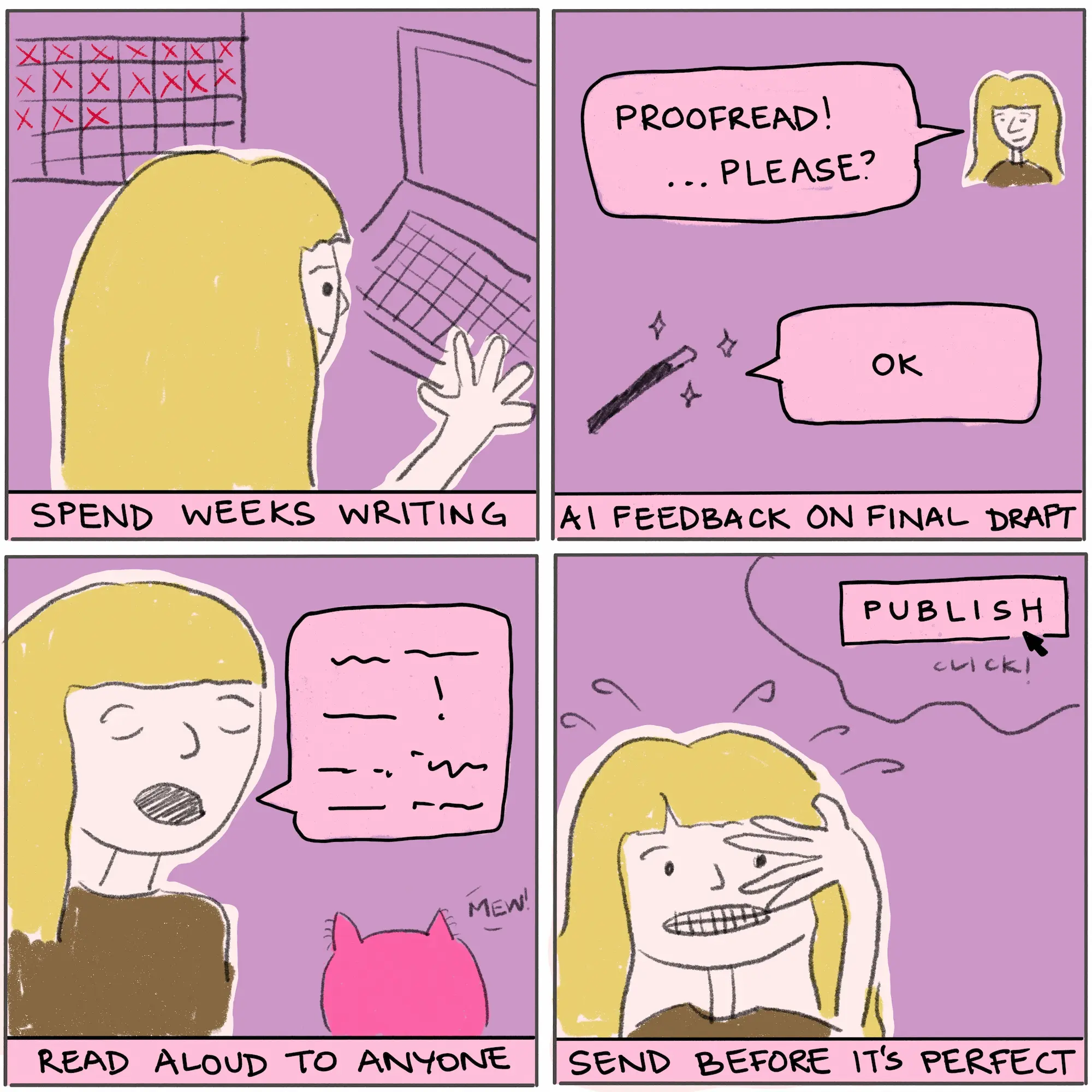
A four-panel comic depicting my process for writing blogs. In the first panel, a person is typing on a laptop, and a calendar with many days crossed off is in the background. The caption says: “Spend weeks writing.” In the second panel, there’s a brief conversation with an AI bot: the person says “Proofread! … Please?” And the bot (represented by a magic wand) says “OK.” The caption says “AI feedback on final draft.” In the third panel, there’s person is reading aloud to a cat. The caption says: “Read aloud to anyone.” In the fourth and final panel, the person is grimacing while peeking out from between their fingers. In the upper right-hand corner, there’s a button that says PUBLISH, with an arrow and the sound effect “click!” The caption says: “Send before it’s perfect.”

1. Spend weeks writing

The process of drafting — including thinking and researching — is lengthy. But it’s a necessary process, and it’s really why I write. It’s only through thinking about a topic, researching it, drafting and redrafting that I discover my own perspective on it. I write to think.

This writing process can feel agonising, and I often wonder if I’m ever going to get to the end. In these times of accessible generative AI, it’s tempting to want to relegate the writing to a bot and skip this stage altogether. But if I didn’t agonise over the writing, I wouldn’t develop my own thinking. And the writing would be homogenised. Outsourcing to AI would completely negate the benefits of the writing process. What’s the point?

2. AI feedback on final draft

I’m not anti-AI! But it’s much better to be brought in as an editor. Once I have my final draft, I’m confident that I’ve done my thinking about the topic, and have shaped it to express my point of view.

I then prompt ChatGPT to review the piece for typos, grammar issues, and inconsistencies. And to give feedback without rewriting. It looks at the piece and then gives back a list of feedback I can use to make adjustments — or ignore!

3. Read aloud to anyone

After I’ve made any changes I’ve decided to accept from AI, I read the post aloud. There’s really no substitute for hearing my writing spoken out loud. This step helps smooth over any awkward phrasing or areas that could be improved rhythmically. I usually just read aloud to myself, but if it’s helpful to read to a friend, family member, pet, or even an inanimate object — go for it!

4. Send before it’s perfect

I know I’m never going to be 100% happy with a blog post. So if I don’t publish it, I will endlessly tweak and agonise over it forever. I’ve learned to trust that in the writing and editing process, I’ve extracted all my thoughts and shaped them into something, and I’ve polished it as best as I can. It’s time to get it out into the world!

2 responses to “My blog writing process”

  1. aisajib Avatar

    I usually never send the full post to ChatGPT. I’ll use various AI tools to brainstorm ideas, flows, headings and titles. For grammar and proofreading, I rely on “traditional” browser-based tools (Grammarly, which is increasingly getting annoying with its never-ending suggestions; or LanguageTools as a plugin inside Obsidian).

    If I feel like a particular sentence or paragraph could be improved, I paste that into ChatGPT (and others — these days I find Apple Intelligence good enough for simple rewrites; it’s on-device (therefore, private), fast, and free without limitations).

    I don’t usually feed the full post because, even if you ask it not to rewrite anything, I’ve caught it changing sentences before, which my tired eyes failed to catch right away.

    1. Tess Needham Avatar

      Nice, thanks for sharing your workflow! Writing is such a personal thing, so it stands to reason that writers will have their own personal ways of using AI. Fascinating. 🙂

Leave a Reply

Discover more from Tess Needham

Subscribe now to keep reading and get access to the full archive.

Continue reading