

My high school art teacher had strong opinions about who the better artists in our class were. According to her, I wasn’t one. I believed her, so I finished school thinking: I’m not an artist.
I stopped making art, but I didn’t stop loving it. I go to galleries and stand as close as I can to the paintings — studying the brush strokes and the colours, trying to understand how someone made something that makes me feel like that.
I memorised the names of artists I would never become.


My life went on. I studied performing arts at university, right up to a PhD.
After I graduated, I had a series of jobs in the university, in television, and in technology. I currently work at WordPress.com, and one of the best parts of my job is that I get to travel around the world, and sometimes get up on a stage and talk to people about creativity.
A return to art
And then, about twenty years after those HSC art classes, I picked up a pencil again. I realised I had stories inside me that needed to get out, and I needed to draw them.
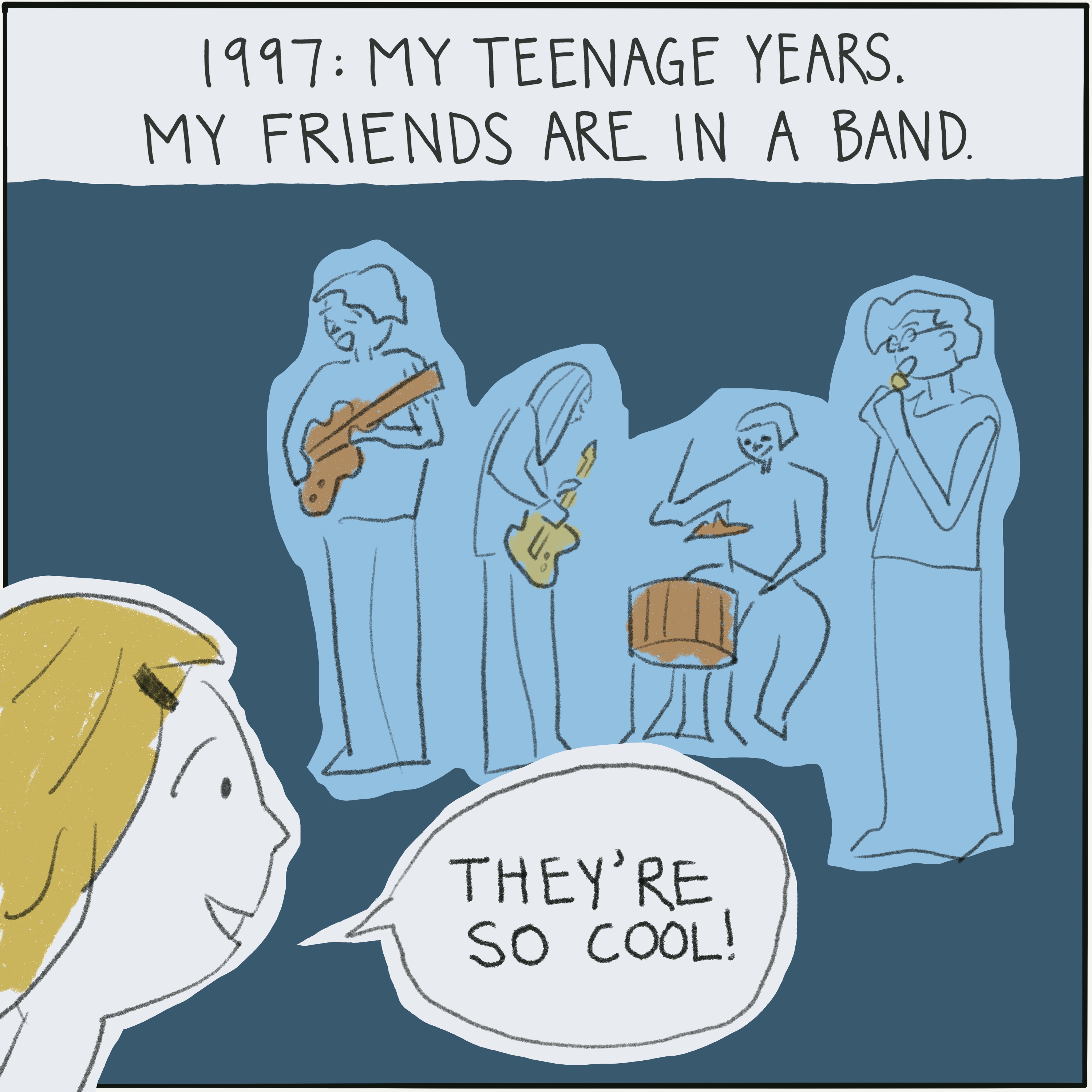
Making art can be such a small, solitary act. It can be deeply personal — just for yourself — but it can also be shared.
For so long, this mode of artistic expression had been off-limits to me, because of the voice in my head telling me I couldn’t do it, that I wasn’t any good. But slowly, I realised that I didn’t need permission. I didn’t need to be talented. I didn’t even need to show anyone my work.
Creating art, expressing myself, gave me so much joy, and I started to think about what this need was, this urge to be creative that was spilling out of me.
Creativity

The way I’ve come to see it, creativity is about filtering what’s happening around you — inputs — through who you are… and making something from it.
It’s taking in things you read, hear, watch, experience, which then become these raw materials that are mixed around with your point of view, your experience, your identity, and your skills. And then, forming that into an output that you share back with the world.
That output could be art, writing, craft, or even how you solve a problem.
But the important part is, because it’s going through that filter of you, no one else can be creative in exactly the same way as you.
A creative PhD
In my PhD research, I was asking a big question: Can performance change the way people think and behave?
But instead of approaching that in a traditionally academic way, I did it creatively. I wrote and performed in a solo performance work that explored body image. I also wrote a thesis, which was later published into a book, that centred my own experience of performing and being an audience member.


I didn’t do it this way because I was rebelling against the academy, or because I thought it would be easier. I did it this way because that was true to myself.
I found that certain kinds of performance can be genuinely transformative. Especially those that are grounded in our personal experience, our stories, that we are brave enough to share with the world.
The power of story
I have the privilege of sharing my story, because I’m standing on the shoulders of many women throughout history who broke the cycle of having their voices and stories silenced.
Women’s creativity and stories have historically been undervalued compared to those of men.

In this painting by Frida Kahlo, she’s standing next to her husband, Diego Rivera. At the time they were alive, he was much better-known than her. She wasn’t famous until after she died, even though these days, probably more people have heard of her than of him.
Many female writers have published under male names, just to be taken seriously. Many female scientists had their hard work credited to men.
And when women aren’t able to tell their stories, we all suffer. Our worldview becomes smaller, and we become less inclusive, and less diverse.
When more women, and more people overall, are brave enough to go through the process of self-discovery, and then use that knowledge of the self to create something new, we all win.
Creativity and abundance

It’s not only a win for how we feel about ourselves. When you practice creativity, this magic thing happens. More creativity comes. There is always enough creativity to go around. It’s self-generating.
Even more, creativity makes us kinder to each other. Artist Wendy MacNaughton talks about drawing, which is really about seeing:
“Drawing is looking, and looking is loving.”
— Wendy MacNaughton
When you create something, you’re paying attention. Your attention is the most valuable thing you can give. You’re caring about the thing that you’re drawing.
Give to gain
So when I think about this year’s International Women’s Day theme — “Give to Gain” — this is what it means to me.
When you give your creativity — your perspective, your voice — you’re not taking something away from anyone else. You’re adding your story to the world. There isn’t a limited number of ideas or opportunities. When you contribute something, you create more space — not less. And when you do that, you gain something too.
These benefits of creativity have also created opportunities in my career. Even when my job hasn’t had the word “creative” in the title, I’ve brought creativity into everything I do. I can’t help it.
On this International Women’s Day, I hope you think about how you can give something creative to the world. Because when you do, we will all gain connection, kindness, and joy.
Leave a Reply