
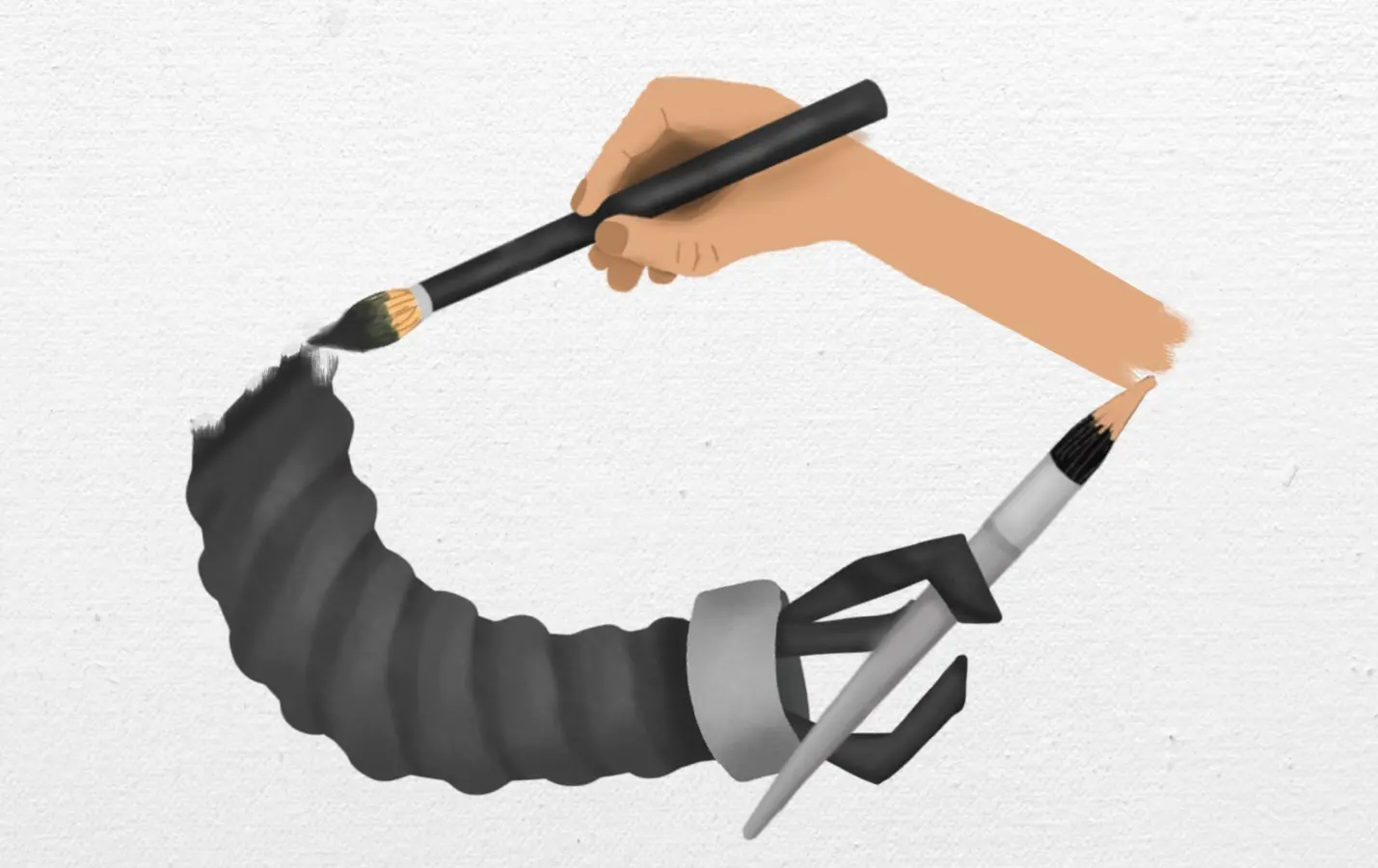
Content marketers, and other creative professionals, are under pressure to be faster, more productive, and more creative. And to do all that, we’re expected to use AI.
We’re expected to befriend the very robots that are coming for our jobs!
But AI is not going away. And creatives need to figure out a way to embrace AI as a tool, and even as a collaborator. But we can — and must — set the ground rules for where and when it’s used.
We have the opportunity to shape expectations and understandings of where AI fits in the content marketing world. We can do this by understanding the boundaries of AI, and the unique value of humans in the creative process.
We can embrace the robots.
Ways creative content marketers can use AI
Let’s start with a very high-level view of the content creation process:

AI tools have the potential to help marketers at each of these stages. But there are also some parts of the process where a human touch is essential.
Preparation
In the preparation stage, marketers are doing research into topics to cover, doing competitive analysis, audience research, getting insights from analytics, and brainstorming ideas. While a lot of this work benefits from the human touch (especially to check AI output and ensure it aligns with business strategy and common sense), there are a lot of potential ways to use AI tools effectively.
Some ideas:
- Research. Quickly generate lists of topics to create content around by going to the main subreddit for your niche. Sort by top questions, then put these into an AI tool and ask it to generate content ideas based on these. Synthesise data you have about your customers, like quotes from reviews, support tickets, and use AI to develop customer personas from them.
- Insights from analytics. Use AI to get suggestions for headlines, or content topics to write about next, based on what’s performed well in the past.
- Content strategy. Meeting notes, business goals, existing content libraries, and other research can be fed into an AI tool to help build a content plan. From there, we can build ideas about experiments and tests to run.
- Brainstorming. When I’m brainstorming with AI, I’m not looking for it to generate its own ideas. I’m focussed on prompting it to remix my thoughts and reflect them back to me in different ways. Just like great art doesn’t happen in a vacuum, it sparks my creativity to throw a jumble of ideas into the mix and see what combinations can be made.
Generation & refinement
This is where the rubber meets the road: where content is actually created. I tread carefully here, since I’m not into content that’s generated wholesale by AI tools. (Google also isn’t into it.) I have some rules about where in the content creation process I use AI. For example, I don’t use it for the first draft of external content. The first draft is the thinking draft. In other words, writing is how we figure things out. I also ensure that the last draft is done by a human, as a final check on tone and voice.
Some ideas:
- Content generation. I only generate text, not images, audio, or video. That’s because text is easy to edit after it’s generated. With images, audio, or video, they’re presented in a more “finished” state, and the only way to edit is to continue prompting, not to dive in there, plop in the cursor, and type or delete away. Text makes it easier for a human to be in the loop.
- Editing email sequences. Emails have a lot of different components (subject line, pre-header, greeting, CTA, sign-off, etc). And they can easily be tested. AI tools can help me (from a human-created draft) to generate alternate options for these components for testing, or to ensure that multiple emails in a series are consistent.
- Transcription. Transcribing interviews, presentations, and events is the kind of uncreative busywork that is perfect to outsource to AI. From transcripts, multiple pieces of content can be created for different channels. Transcriptions are also very helpful for video captions (with a human checking the output, of course!).
- Summarisation. From transcripts, create summaries that can be used as the basis for other types of content. Large, pillar pieces of content can also be summarised and broken down into themes or smaller topics.
- Tone, voice, and grammar checks. AI tools can be trained on style guides and verbal guidelines, and flag opportunities to correct things like acronyms, abbreviations, product names, and also suggest rewrites in a different tone.
Publication
Once the content is created and refined, and a human has done a final edit, it’s time to share it with the world. At this stage, there are multiple non-creative tasks on a content marketer’s list that can be assisted by AI.
Some ideas:
- Internal linking. Linking to other pages or posts on your own site is important for SEO, but it can be one of the most tedious tasks for content marketers. This is where AI can be really helpful, as some tools can scan your site for certain keywords, and suggest related content to link to.
- Metadata. Once a piece of content is written, AI tools can be used to generate metadata like excerpts, tags, and categories. Writing this metadata is usually busy work for the content marketer, and it’s become significantly easier with AI.
- Pre-flight checks. Pre-AI, final checks were best done by someone with little to no involvement with the project, as fresh eyes can surface many things that were invisible to people close to the project. With AI, these tools can help with those tasks of proofreading, final grammar and spelling checks, and identifying inconsistencies and repetitive words and phrases.
- Social posts. AI tools can help generate derivative copy for other channels, rewriting for tone, format, platform, and audience. This saves a lot of time, as it can pick up on the main ideas of a post, create a post in the required number of characters, add emojis and hashtags, and more. It can also create a series of posts, or anything else within parameters you set.
Looking at this in chart form, we can see the rise and fall of AI’s potential throughout the process:

But let’s not stop there. Just for fun, doesn’t this remind you of something?
Anyone else see a robot shark? No? Just me?

Oh well, since I’m a marketer and I like to name things, I can’t resist giving this theory of AI potential across the content creation process a catchier name:

If you follow Jaws Law, you’ll be able to embrace AI without losing your soul.
Conclusion
When figuring out how to use AI in the creative content marketing process, don’t panic! Remember:
AI is not creative
The heart of creativity is still uniquely human. AI is not creative. Taste, messiness, struggle, self‑reflection, joy — these aren’t things machines can replicate. They’re the reason our work resonates.
Not all content marketing is creative
There are plenty of parts of content marketing that don’t need human creativity anyway — and that’s not a threat, that’s an opportunity. These are the tasks that AI can take off our plates.
You can collaborate with AI
Creative content marketers can overcome skepticism and collaborate with AI. When we use AI thoughtfully, we don’t lose our creative role — we expand it. By letting AI handle the non‑essential tasks, we free ourselves to focus on the parts of content marketing that truly require us, and we build deeper connections as a result.
P.S. These ideas — and more! — were included in my talk Welcoming our Robot Collaborators: AI and Creativity in Content Marketing at the MarketingProfs B2B Forum last week.

At the conference, I gave out these zines. If you weren’t there, you don’t have to miss out — download and print your own copy here! (Please follow Austin Kleon’s excellent instructions for folding. And note — I’m in Australia and we use the incredibly logical ISO 216 standard for paper sizes. This zine was printed on A4 paper, so if printed on US Letter (bleh), it may not look as intended.)
Leave a Reply