
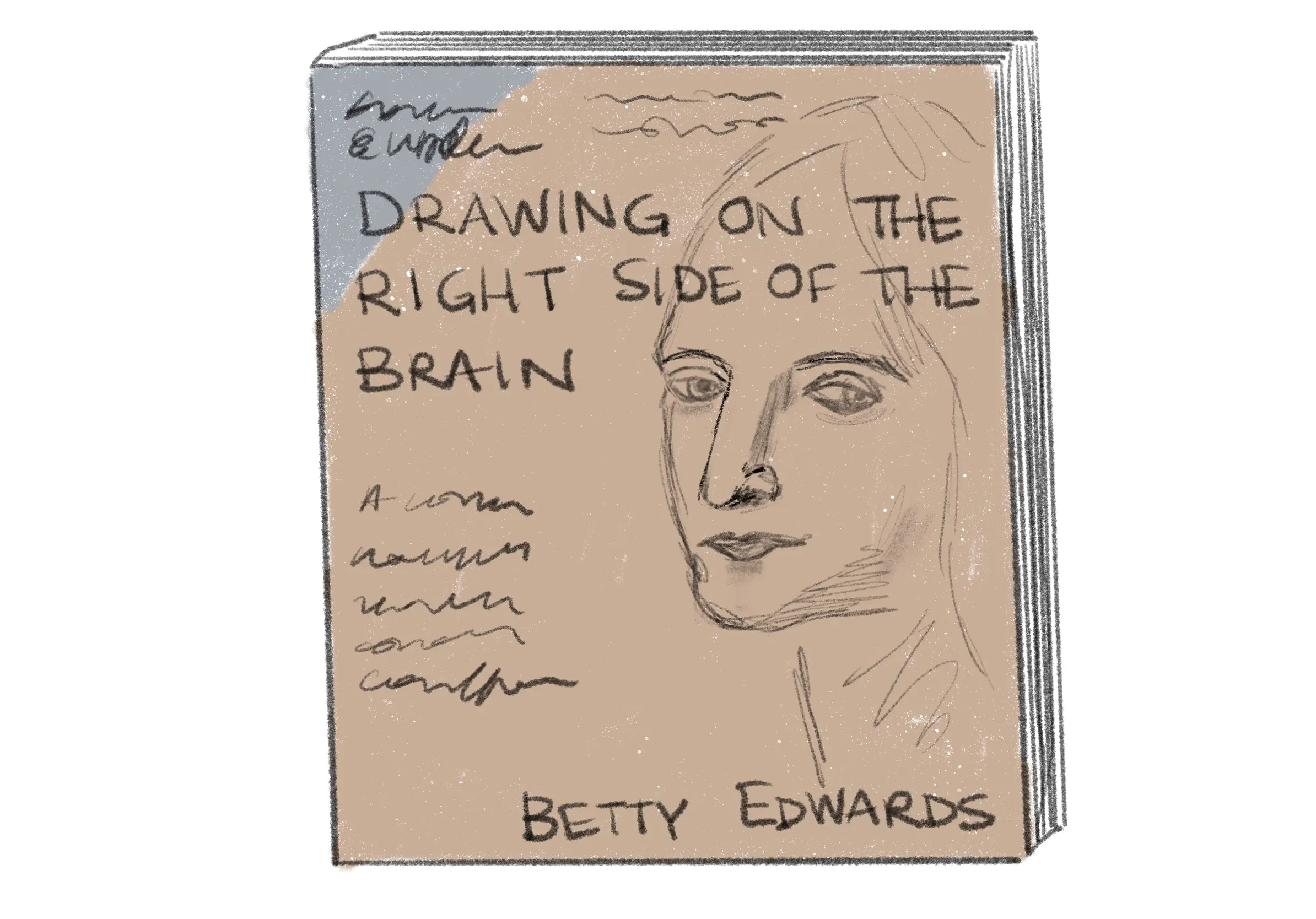
Drawing on the Right Side of the Brain by Betty Edwards is one of those classic books that every art teacher loves to reference. It’s a great book for learning to draw, with a mix of the philosophical side (why draw?) and the practical side (draw upside-down!).
Better drawing = better thinking
Edwards’ premise is that the arts improves thinking. And that the arts should be an important part of the education system — not to produce more working artists (our society can’t support the artists we have now), but to improve thinking skills in general.
“Having learned to know perceptual skills by using them in drawing will enhance your success of transferring visual skills to thinking and problem-solving. You will see things differently.”
For example, training the brain to draw the edges of an object or a scene will help you see the edges of a problem.
Elements of drawing
The book contains exercises covering the identified five basic skills of drawing:
- The perception of edges.
- The perception of spaces.
- The perception of relationships.
- The perception of lights and shadows.
- The perception of the whole, or gestalt.
Edwards outlines the dual nature of human thinking — that verbal, analytical thinking is mainly located in the left hemisphere of the brain (L-mode), and visual, perceptual thinking is mainly located in the right hemisphere (R-mode).
She asserts that the reason so many people think they can’t draw, and therefore don’t, is that more of us need to make the cognitive shift to R-mode for drawing.
The “dual hemisphere” creative process
Apart from all the useful discussion and exercises in the book, I especially liked the focus of Chapter 11 (in my version of the book, the 4th edition), which outlines how the left brain-right brain framework comes into the creative process:
- First insight (R-mode leading). In this phase, the creative discovers problems by visually searching, or by chance. They are surveying the world, taking in a lot of data and finding what stands out. The best question to ask in this phase is “I wonder how come…?”
- Saturation (L-mode leading). This is the research phase, in which the creative asks questions like: “What is already known about the problem? Has it already been solved?” If the question remains unanswered, this frustration causes the person to become overloaded and need to take a break from thinking about it.
- Incubation (R-mode leading). While the creative is taking a break and focussing on something else, their right brain goes to work on the problem.
- Illumination (R-mode and L-mode together). Both hemispheres celebrate the solution that appeared in the incubation phase. This is the “aha” moment. (I particularly liked this one, given the presence of illumination in alchemy!)
- Verification (L-mode guided by R-mode visualisation). The final phase of the creative process is the least glamorous, and involves doing the work to put the insight into its final form. This phase doesn’t feel as joyful as the other phases, and as a result, many creatives stop before completing it.


Leave a Reply