
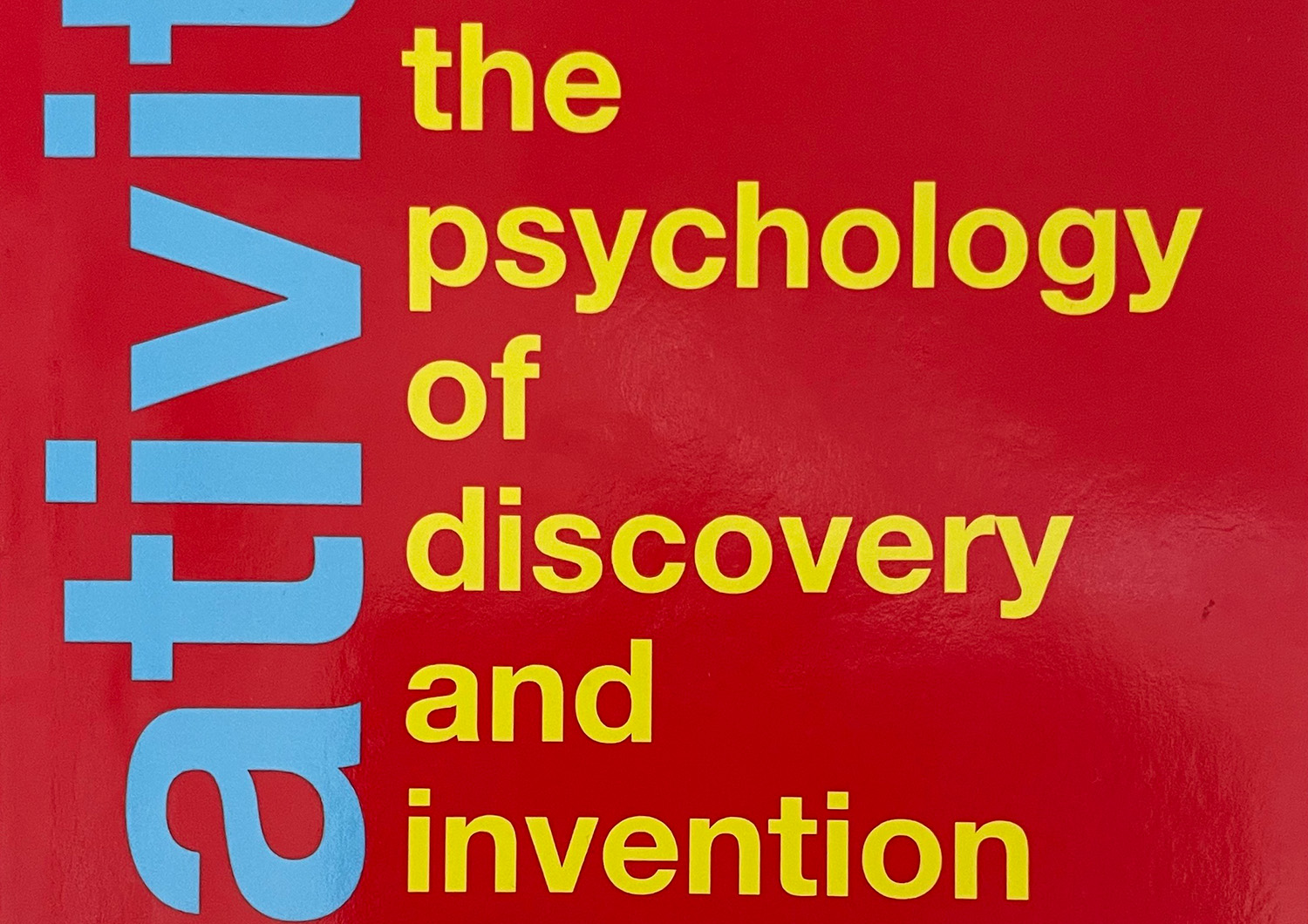
I picked up Creativity: the Psychology of Discovery and Invention by psychologist Mihaly Csikszentmihalyi despite the way the vibrating colours on its cover make me feel like I’m constantly on the verge of a headache.
Having read and enjoyed Csikszentmihalyi’s previous work, Flow, I looked forward to diving into a more rigorously academic work on the topic (no offence, John Cleese!). As with Flow, Creativity is long, thorough, and precise, although still readable.
Through a series of interviews of creative people, this book interrogates the similarities between the character traits of creative people, and common threads of how people approach creative work.
Defining creativity
Csikszentmihalyi makes it very clear that it isn’t just about some wishy-washy artists painting and smoking all day and calling themselves creative. No, to be able to study creativity scientifically, it needs to be defined within much less lenient terms.
Csikszentmihalyi breaks this down by defining three “phenomena” of creativity:
- People who are unusually bright.
- People who experience the world in novel and original ways (“personal creativity”).
- People who have changed our culture in some important respect with their public achievements (“cultural creativity”).
He chooses to focus on the third type of creativity, regarding people as “creative” only when they have been accepted by their own domain as having changing it in some way.
“Creativity is any act, idea, or product that changes an existing domain, or that transforms an existing domain into a new one.”
My own definition of creativity tracks closer to number 2 in this list, but Csikszentmihalyi notes that this mode is subjective, so it’s difficult to “deal with” in a scientific study.
This narrow definition of creativity made much of the book irrelevant for the type of creativity I’m interested in. But, it does still contain many interesting nuggets from the creatives interviewed.
In order to be successful, creatives need:
- A big “database” of existing work—deep knowledge of the domain they’re creating in.
- To be willing and excited to generate a lot of ideas.
- The ability to “internalise” domain acceptance by knowing the difference between their good and bad ideas—getting rid of the bad, and pursuing the good.

Steps towards a creative life
The best part of the book, in my opinion, is the final chapter that lists advice for creativity. From the similarities between creatives interviewed in the book, Csikszentmihalyi makes some recommendations for “steps towards a creative life”:
Curiosity and interest
Creatives must allocate their attention to things for their own sake:
- Try to be surprised by something every day.
- Try to surprise at least one person every day.
- “Make experiences less fleeting” by writing down each day what surprised you and how you surprised others.
- When something strikes a spark of interest, follow it.
Cultivating flow in everyday life
Relearn to enjoy curiosity by:
- Waking up in the morning with a specific goal to look forward to.
- Transform everyday activities so they are more enjoyable. If you do anything well, it becomes enjoyable.
- To keep enjoying something, you need to increase its complexity.
Habits of strength
Protect against distractions and interruptions by:
- Taking charge of your schedule.
- Making time for reflection and relaxation. This doesn’t mean doing nothing, but doing something different than you normally do. Preferably something physical that requires some, but not all, of your attention.
- Shaping your space.
- Finding out what you like and what you hate about life (know thyself).
- Doing more of what you love, and less of what you hate.
Problem finding
Focus on issues that will affect your experience but may otherwise go unnoticed by:
- Finding a way to express what moves you.
- Looking at problems from as many viewpoints as possible.
- Figuring out the implications of the problem.
- Implementing the solution.
Divergent thinking
Stimulate the fluency, flexibility, and originality of your ideas and responses by:
- Producing as many ideas as possible.
- Having as many different ideas as possible.
- Trying to produce unlikely ideas.
Although the book defines creativity based on public domain acceptance, Csikszentmihalyi acknowledges that personal creativity is still valuable. When we are involved in creativity, we feel that we are living more fully. And even if that creativity is not “big c creativity” (making waves in a certain domain), the personal fulfilment is still worthy.
“When we live creatively, boredom is banished and every moment holds the promise of a fresh discovery”
But that cover still makes my eyes water.
Leave a Reply