
Often at art museums I’ll see groups of art students sitting on the ground, looking intently at an artwork and copying it into their sketchbook.
In Peter Jackson’s The Beatles: Get Back, I saw Paul McCartney playing a range of songs by other artists, exploring riffs or chord progressions he liked.
There’s a lot to learn from copying the work of others.
More than just looking at an artwork, replicating it with my own hands is a way to get inside the mind of another artist. To explore their creative choices, their linework, their use of colour.
I’m not suggesting I copy another work and pass it off as my own. But by studying and trying to replicate an artistic style I admire as an exercise, it helps me step into the mindset and skills of the artist who created it.
As Neil Cohn outlined in Speaking in Pictures, imitating drawings is an effective way to learn and improve drawing skills, as well as develop a unique artistic style. We copy handwriting to learn it. We copy speech to learn it. Why should drawing be different?
When I copy other artists, I’m paying attention to what I like about their work. I’m exploring my own taste, and what I’m drawn to. Then when I create something new, it’s never really completely new. I’m mashing together different influences to make something from my own voice.

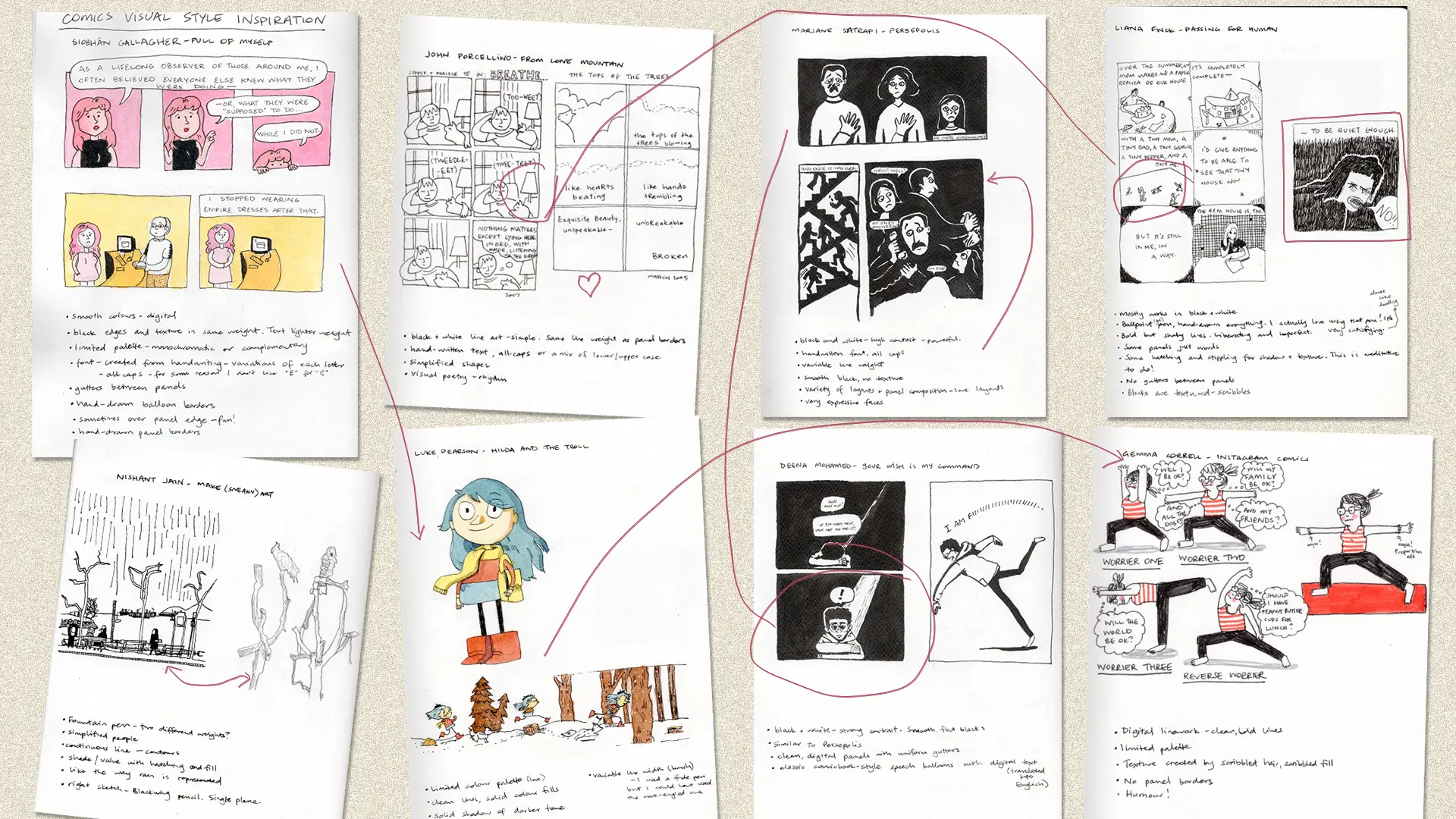
Over the past few weeks, I copied panels from some of my favourite comic artists, and wrote down what I liked about their style. I learned more about my own taste through the specific elements of comic art that grab my interest.
- The story, and the ideas, are more important than perfectly proportioned or realistic art. This is liberating!
- All-caps, hand-written text in speech balloons or captions. I like to hand-write text in comics because it’s an additional place to add personality and style.
- Simple linework. Some artists have uniform line thickness (like that created with a fine liner) and some have variable (like that created with a brush). Personally, I prefer the look of the brush.
- Flat colours, with cel shading. I like the simplified and bold look of cel shading (where there’s a hard line on the edge of the shading, rather than a gradient).
- Sometimes breaking panel borders. Panel layout and border style isn’t something I’ve thought much about in the past, but it can be really effective for drawing the viewer in and adding variety and focus.
- Closed shapes for outlines. I tend to create open shapes (with gaps in them), but most of my inspiration artists used closed shapes. These do help the comic read more cleanly, especially when there are a lot of lines on the page.
Along with these stylistic elements I’ve copied from artists I admire, I’m also drawn to:
- Collage, as I’ve used in my own graphic memoir stories. I like way collage adds an interesting variety of textures, patterns, and depth.
- Embroidery, for example The Dancing Plague and my own embroidered illustrations of obsolete communications devices. I like how embroidery takes time, and this time spent in the process is evident in the finished product.
- Watercolour, as in my urban sketches. I love the texture and random variations in tone.
As Austin Kleon recommends, I’ll Steal Like an Artist and take all of this inspiration with me into my next creations.
Leave a Reply